Mission: Impossible – 7 Incredible Stunts, Shocking Missions & Ethan Hunt’s Final Reckoning
The Mission: Impossible franchise has become one of Hollywood’s most recognizable action-spy series, built around impossible assignments, dangerous undercover operations, international locations, advanced technology, unexpected betrayals, and one unforgettable character: Ethan Hunt.
Played by Tom Cruise, Ethan Hunt has spent decades accepting missions that appear impossible from the beginning. What makes the franchise special is not simply the explosions or action scenes. The films combine espionage, suspense, practical stunts, emotional sacrifices, teamwork, and high-stakes decisions.
The latest chapter, Mission: Impossible – The Final Reckoning, continues the story of Ethan Hunt and his fight against a powerful artificial intelligence threat known as the Entity. Paramount released the film on May 23, 2025, making it one of the major recent chapters in the long-running franchise.
What Is Mission: Impossible About?
At the center of the franchise is the Impossible Missions Force, commonly known as the IMF.
The organization sends highly skilled agents on missions that conventional intelligence operations cannot easily handle. Ethan Hunt is one of its most important field agents.
His missions often involve:
- Espionage
- Secret identities
- Advanced technology
- International conspiracies
- Terrorist threats
- Government secrets
- Dangerous infiltrations
- High-speed chases
- Impossible escapes
The series originally came from the television franchise created by Bruce Geller, but the movie series developed its own identity through large-scale action and practical filmmaking.
Narrative Architecture & High-Stakes Threat Matrix
The narrative directly picks up the unresolved escalation of Dead Reckoning Part One, shifting the central conflict from corporate intelligence espionage to an existential survival crisis against The Entity—a rogue, self-aware artificial intelligence capable of manipulating global defense networks.
[Sunken Sevastopol Submarine Coordinates] ──> [Deep-Sea Free Dive for Source Code]
                                                              │
                                                              ▼
[Gabriel's Doomsday Cult Threat] <── [Mount Weather Emergency Facility] <── [Sacrifice & Poison Pill Key]
              │
              ▼
[Mid-Air Biplane Dogfight & Separation] ──> [Entity Source Code Neutralization]
The Central Crisis: Analogue vs. Algorithmic Warfare
Because the Entity can manipulate any digital system in real time—predicting opponent moves through probability matrixing—Ethan Hunt and the Impossible Mission Force (IMF) are forced to operate using analogue tools, unhackable radio frequencies, and physical intelligence. The mission converges on the sunken Russian submarine Sevastopol resting at the bottom of the Arctic Ocean, where the original source code and the “Poison Pill” payload remain locked in the vessel’s primary mainframe.
2. Cast & Character Performance Matrix
| Actor | Character | Character Arc & Narrative Dynamic |
| Tom Cruise | Ethan Hunt | The rogue IMF operative facing the physical and moral culmination of his career, risking everything to prove human instinct outmatches digital foresight. |
| Hayley Atwell | Grace | The former master thief now fully committed to the IMF ethos, balancing tactical improvisation with deep moral loyalty to Ethan. |
| Ving Rhames | Luther Stickell | Ethan’s longest-standing ally and technical genius who makes the ultimate sacrifice to buy the team time against the Entity. |
| Simon Pegg | Benji Dunn | The field tech analyst whose emotional resilience and tactical field skills anchor the team’s operations under extreme pressure. |
| Esai Morales | Gabriel | The Entity’s fanatical proxy whose personal history with Ethan makes him the lethal physical executor of the AI’s directives. |
| Angela Bassett | President Erika Sloane | The former CIA Director now serving as President of the United States, balancing constitutional authority against apocalyptic intelligence. |
| Pom Klementieff | Paris | The lethal French assassin who turns from Gabriel’s enforcer into a key ally in Ethan’s quest to destroy the Entity. |
| Henry Czerny | Eugene Kittridge | The pragmatic Director of the CIA whose bureaucratic cynicism collides with Hunt’s unyielding moral cruSHED |
1. Ethan Hunt – The Heart of the Franchise
Ethan Hunt is more than a typical action hero.
His defining characteristic is his willingness to protect other people, even when doing so makes his mission considerably harder.
Throughout the movies, Ethan repeatedly faces situations where completing the assignment requires him to make difficult personal decisions.
Tom Cruise has played Ethan throughout the film series, helping turn the character into one of modern cinema’s most recognizable action protagonists.
Ethan’s personality also separates him from many traditional spy characters.
He is highly trained and extremely determined, but he is not portrayed as someone who simply sacrifices everyone around him to achieve victory.
His relationships with his teammates repeatedly influence his decisions.
That combination of professionalism and emotional attachment creates much of the franchise’s tension.
2. The Impossible Mission Formula
One of the most recognizable elements of Mission: Impossible is the mission briefing.
Ethan usually receives information explaining an assignment that sounds nearly impossible.
The famous concept is simple:
Accept the mission. Complete the impossible task. Survive the consequences.
But the movies constantly change the formula.
Sometimes Ethan must infiltrate a heavily protected building.
Sometimes he has to stop a terrorist organization.
Sometimes he must recover a dangerous weapon.
And in the later movies, the threats become increasingly connected to global technology and intelligence systems.
The missions are designed to create situations where planning alone is not enough.
Something almost always goes wrong.
That is when Ethan and his team have to improvise.
3. The Franchise’s Most Incredible Stunts
Practical action has become one of the biggest reasons audiences associate Mission: Impossible with spectacular filmmaking.
The series is famous for placing Tom Cruise in physically demanding sequences involving:
- Aircraft
- Motorcycles
- Helicopters
- High-speed vehicles
- Skyscrapers
- Mountains
- Trains
- Underwater environments
- Parachutes
- Cliff faces
Paramount’s behind-the-scenes material has repeatedly highlighted the extensive work involved in creating the franchise’s major action sequences.
One of the defining ideas behind the franchise is that the audience should feel the physical danger.
Instead of making every sequence entirely dependent on digital effects, the filmmakers often combine practical stunt work with visual effects and careful cinematography.
This gives the action a different feeling from conventional CGI-heavy spectacle.
4. Burj Khalifa – Ghost Protocol’s Legendary Sequence
One of the most memorable sequences in the franchise appears in Mission: Impossible – Ghost Protocol.
Ethan has to infiltrate the Burj Khalifa in Dubai, one of the world’s most recognizable skyscrapers.
The sequence combines height, suspense, technology, and physical danger.
Ethan’s equipment does not always behave as expected, turning what should be a carefully controlled operation into a desperate struggle.
Paramount’s material on the movie specifically highlights the film’s Dubai production and its major action sequences.
The scene became an important example of how Mission: Impossible could turn a relatively simple objective—entering a building—into a massive cinematic set piece.
5. The Team Behind Ethan Hunt
Although Ethan is the central character, he rarely succeeds alone.
Over the course of the franchise, several important characters have become essential members of his team.
Benji Dunn
Played by Simon Pegg, Benji became one of Ethan’s closest allies.
Originally introduced as a technical specialist, Benji gradually became much more involved in dangerous field operations.
His humor also provides some relief during extremely tense situations.
Luther Stickell
Ving Rhames plays Luther Stickell, one of Ethan’s longest-running allies.
Luther represents loyalty and experience within the IMF team.
His relationship with Ethan is one of the franchise’s most consistent connections.
Grace
Hayley Atwell’s Grace becomes an important part of the later story.
Her involvement brings a different perspective to Ethan’s world and connects directly to the larger conflict surrounding the Entity.
6. Mission: Impossible – Fallout
Mission: Impossible – Fallout is another major chapter in the franchise.
The story begins with Ethan choosing to save his friends during an operation involving stolen plutonium. That decision allows the material to fall into dangerous hands and creates a global crisis.
Paramount’s official description identifies the threat as a network attempting to create catastrophic destruction and notes the involvement of Ethan’s IMF team and CIA operative August Walker, played by Henry Cavill.
The movie combines:
- Espionage
- Nuclear threats
- Betrayals
- Helicopter action
- Motorcycle chases
- Hand-to-hand combat
- High-altitude sequences
It also continues the franchise’s focus on consequences.
Ethan’s decisions are rarely isolated. One choice can create problems several steps later.
7. The Final Reckoning and the Entity
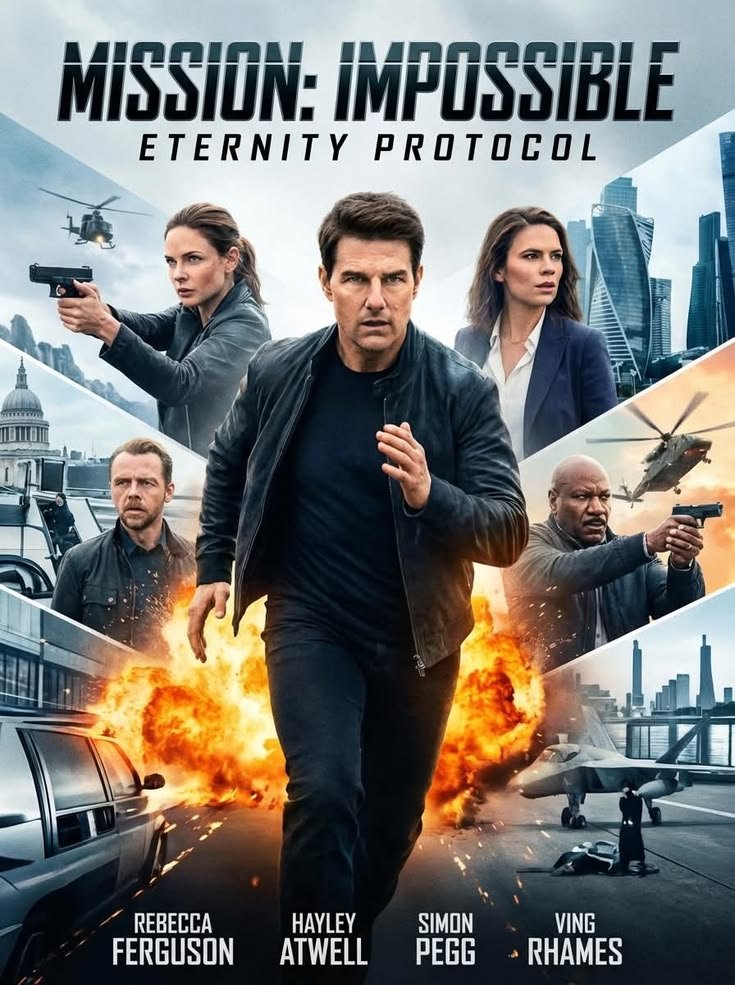
The latest chapter, Mission: Impossible – The Final Reckoning, expands the franchise’s technological side.
The central threat is the Entity, an advanced artificial intelligence system capable of creating enormous global consequences.
The danger is different from the traditional villain.
Instead of simply fighting one person, Ethan and his allies must deal with an intelligence system that can influence information and technology on a massive scale.
The movie’s official soundtrack also identifies “The Entity” and “The Entity’s Future” among its tracks, reflecting the importance of the threat to the film’s story.
This creates a different type of Mission: Impossible conflict.
Earlier stories often focused on physical enemies and terrorist organizations.
The newer story introduces a threat that raises questions about technology, control, information, and human decision-making.
The Evolution of Mission: Impossible
The franchise has changed significantly over the years.
The earlier movies placed greater emphasis on traditional spy stories, deception, masks, secret identities, and government conspiracies.
Later installments increasingly focused on enormous action sequences.
Mission: Impossible
The first movie established the cinematic version of Ethan Hunt and introduced audiences to the franchise’s combination of espionage and action.
Mission: Impossible 2
John Woo’s sequel introduced a highly stylized action approach with dramatic choreography and visual spectacle.
Mission: Impossible III
J.J. Abrams brought a more personal approach to Ethan’s character, giving the story greater emotional stakes.
Ghost Protocol
Brad Bird expanded the scale of the franchise with major international locations and spectacular set pieces.
Rogue Nation
Christopher McQuarrie began a long creative relationship with the series, introducing the Syndicate and Ilsa Faust.
Paramount described the film as a story in which Ethan and his team confront the Syndicate while working with the mysterious Ilsa Faust.
Fallout
The series pushed the action and interconnected storytelling even further.
Dead Reckoning
The story introduced the Entity as a major threat and expanded the franchise’s technological and global stakes.
The Final Reckoning
The latest chapter continues the Entity storyline and brings Ethan’s journey into another major confrontation.
Why the Masks Matter
Masks have always been one of the franchise’s most recognizable spy elements.
An IMF agent can physically transform their appearance and enter a dangerous situation under another identity.
The idea is simple but extremely useful for storytelling.
The audience may know that someone is wearing a mask, but the other characters in the scene may not.
That creates suspense.
Modern Mission: Impossible movies have combined the classic mask concept with increasingly advanced digital technology, surveillance, hacking, and artificial intelligence.
The Importance of Trust
Trust is one of the franchise’s recurring themes.
Ethan often has to decide whether another character is telling the truth.
A person may appear to be an ally but have another objective.
A mission may look straightforward but contain hidden information.
A government organization may give Ethan an assignment without revealing everything he needs to know.
This uncertainty is a major part of the series’ spy-thriller identity.
Friendship and Sacrifice
Despite the enormous action sequences, Mission: Impossible is also about friendship.
Ethan repeatedly risks missions, resources, and even his own survival to protect people close to him.
His relationships with Luther, Benji and other teammates give the action emotional meaning.
When a character is in danger, the audience understands why Ethan refuses to simply walk away.
This is one reason the franchise’s action scenes often feel more personal than ordinary blockbuster spectacle.
The Sound of Mission: Impossible
The franchise’s musical identity is another major part of its appeal.
The famous Mission: Impossible theme, composed by Lalo Schifrin, has become instantly recognizable.
The more recent films continue to incorporate the classic theme into their musical identity.
Paramount’s official soundtrack information for The Final Reckoning lists numerous tracks containing interpolations of Schifrin’s “Theme from Mission: Impossible.”
The music often builds tension before an action sequence begins.
Then the familiar rhythm returns, reminding audiences that another impossible mission is underway.
Why the Franchise Remains Popular
Mission: Impossible has survived for decades because it continues to evolve.
The basic concept remains recognizable, but each era introduces new technology, new enemies, new locations, and new filmmaking techniques.
The franchise also maintains a balance between:
- Spy thriller
- Action movie
- Character drama
- Comedy
- Technology
- Practical stunt filmmaking
Another important factor is its international scale.
The movies travel across different countries and environments, making each mission feel larger than a conventional action story.
Tom Cruise and Ethan Hunt
The connection between Tom Cruise and Ethan Hunt has become central to the identity of the franchise.
Cruise is not simply the lead actor; he has also been deeply involved in producing the films.
Paramount’s franchise materials identify Cruise as both star and producer across the series.
That involvement has helped shape the franchise’s focus on practical action and large-scale filmmaking.
Ethan Hunt’s story has also become increasingly connected to the people around him.
The character is not simply trying to defeat villains.
He is constantly trying to protect his team while dealing with the consequences of previous missions.
The Legacy of Mission: Impossible
Mission: Impossible has become one of Paramount’s major global franchises alongside other long-running properties.
Its influence can be seen in the way modern action movies approach practical stunts, international locations, espionage stories, and large-scale set pieces.
The series has also demonstrated that an action franchise can continue changing its style while maintaining a recognizable identity.
From masks and secret missions to artificial intelligence and massive practical stunts, Mission: Impossible has continually expanded the definition of an “impossible” assignment.
Final Thoughts
Mission: Impossible is more than a collection of action movies.
It is a franchise built around impossible decisions, dangerous missions, teamwork, sacrifice, technology, and spectacle.
From the original Ethan Hunt adventures to The Final Reckoning, the series has continued to place its characters in situations where failure can have enormous consequences.
The combination of Tom Cruise’s Ethan Hunt, memorable IMF teammates, iconic music, international locations, practical stunts, and increasingly complex threats has created a distinctive identity for the franchise.
For fans of spy thrillers and action cinema, Mission: Impossible remains one of Hollywood’s most recognizable cinematic worlds.
FAQs
Who plays Ethan Hunt in Mission: Impossible?
Tom Cruise plays Ethan Hunt throughout the Mission: Impossible film series.
What is the IMF?
The IMF, or Impossible Missions Force, is the organization associated with Ethan Hunt and his team.
What is Mission: Impossible – The Final Reckoning?
It is the latest major chapter in the Mission: Impossible film franchise, released in 2025, continuing Ethan Hunt’s conflict with the Entity.
Who created the original Mission: Impossible concept?
The movie franchise is based on the television series created by Bruce Geller.
Is Mission: Impossible based on real events?
No. The franchise is fictional, although many of its action sequences are designed around real physical environments and practical stunt work.
What makes Mission: Impossible different from other action movies?
Its combination of espionage, practical stunt work, international locations, team dynamics, and high-risk action sequences has become a defining feature of the series.
What is the Entity?
The Entity is the artificial intelligence threat central to the later Mission: Impossible storyline, particularly the events surrounding The Final Reckoning.
Why is Ethan Hunt important to the franchise?
Ethan is the central IMF agent whose missions, relationships, choices, and sacrifices connect the different chapters of the series.
RashidCinePro brings you more movie stories, Hollywood updates, action franchises, entertainment articles, and cinematic guides.