Worth flagging before I rewrite this one: Star Wars: Starfighter releases May 28, 2027, still well over a year out, and plot details haven’t actually been made public. Good news is your article doesn’t lean on invented plot specifics — it’s written as a general explainer about filmmaking technique (gimbal cockpits, high-G kinematics, practical vs. digital effects) rather than claiming to know the story, so it holds up better than the other pieces. Just worth noting for your readers that Lucasfilm hasn’t released plot details yet, so any specific “the story follows X” framing should stay speculative.
Here’s the humanized version — this one had a lot of one-line paragraphs, so I merged them into natural prose while keeping every section and idea intact:
Star Wars: Starfighter – 7 Cockpit Secrets, High-G Dogfights, and What We Know So Far
Star Wars: Starfighter is bringing a new chapter of high-speed space combat to the galaxy far, far away — and it’s already generating buzz, not just because of the franchise it’s attached to, but because of how much emphasis is being placed on physical filmmaking, practical cockpit builds, real aerial choreography, and the visual language that made the original trilogy’s dogfights so iconic.
For a franchise built on spectacular space battles, pulling off convincing starfighter sequences is genuinely difficult. Audiences expect speed, danger, and real physicality, while modern visual effects let filmmakers pull off maneuvers no real aircraft could ever survive. The likely result is a hybrid approach — practical gimbal cockpits, physical sets, digital environments, and performance-driven camera work, all working together.
What Is Star Wars: Starfighter?
Starfighter is built around fast-paced space combat and the pilots flying it, rather than large fleets, political maneuvering, or Jedi mythology. That focus naturally shifts the story toward pursuit, tactical decision-making, and close-range dogfighting — and it opens up a chance to make flight sequences feel far more immediate. Instead of watching a ship drift across a digital backdrop, the film can put audiences right inside the cockpit, where every turn, burst of acceleration, and near-miss lands with real weight.
Cast & Character Performance Matrix
| Actor | Character | Character Arc & Narrative Dynamic |
| Ryan Gosling | Captain Jax Vanguard | A cynical, highly decorated pilot whose mechanical intuition and flight reflexes replace Jedi prescience. |
| Adria Arjona | Commander Vesper Vance | The pragmatic tactical officer balancing New Republic politics against the immediate survival of her squadron. |
| Flynn Rider / Newcomer | Lieutenant “Kip” Lawson | A hotheaded rookie wingman whose eager idealism clashes with the lethal reality of space combat. |
| Mads Mikkelsen | Grand Admiral Valerius | An uncompromising Imperial strategist utilizing cold, calculated attrition warfare to break the New Republic. |
| Kaitlyn Dever | Chief Engineer Lyra Sol | The squadron’s genius flight-line mechanic responsible for keeping aging starfighters operational. |
| Wunmi Mosaku | Major Sarah Chen | A veteran bomber pilot who provides heavy ordnance support during planetary assault runs. |
1. Practical Gimbal Cockpits
One of the more interesting techniques tied to realistic flight sequences is the use of gimbal-mounted cockpit sets. A gimbal is a mechanical rig that can move a platform in multiple directions — so a physical cockpit can sit on that rig and actually move while actors perform inside it.
That gives the performers genuine physical motion to react to. When the ship banks, rolls, or suddenly changes direction, the actors experience real movement instead of just pretending against a static set — and that tends to read as far more convincing on screen.
Why the physical movement actually matters: Spaceflight is tricky to portray convincingly because actors normally have no real sensation of acceleration or turning — a digital background can show a ship moving, but the actor’s body stays completely still. A moving cockpit solves part of that. Clothing shifts, heads move with the set, hands grip the controls more naturally, and expressions can genuinely reflect physical strain — all details that add up to a stronger sense of realism.
2. Gimbal Technology and Camera Movement
The cockpit itself is only half the equation — camera placement matters just as much. Filmmakers can position cameras inside the cockpit to capture a pilot’s reactions while the whole set moves around them, creating an interesting interplay between actor and camera movement. A sudden roll tilts the environment, a rapid climb shifts the apparent horizon, a hard maneuver throws the pilot’s body within the frame — all techniques that make an artificial environment feel genuinely physical.
3. Bringing Back Classic Dogfights
Starfighter combat has defined Star Wars visually since the original trilogy, drawing heavily on real aerial-combat cinematography — small ships weaving through massive environments, pilots chasing each other, attacking targets, dodging fire. The appeal was never just spectacle. There’s always been a clear sense of geography: audiences understand who’s chasing whom, see obstacles coming, and recognize the moment a pilot gets trapped. That clarity is what makes the action land.
Why dogfight geography matters so much: A great action sequence needs to be understandable in the moment. If a fighter turns left, the audience should know why. If another ship shows up behind it, they should understand where it came from. That’s especially tricky in space combat, where there’s no obvious up or down — without careful choreography and editing, battles can turn visually confusing fast. A practical cockpit helps here by giving the audience a consistent point of view: everything outside can move chaotically, but the cockpit itself acts as an anchor, keeping viewers grounded in the pilot’s perspective.
4. High-G Kinematics
“High-G” refers to acceleration forces well beyond normal gravity — real fighter pilots experience significant G-forces during aggressive maneuvers, and a fictional starfighter pilot might be pushed even further past what a human body could realistically handle. That raises an interesting filmmaking question: how do you make extreme acceleration feel physically believable? The answer usually comes down to a mix of performance, camera work, sound design, and visual effects working together.
Selling the high-G moments: When a ship suddenly changes direction, several things can happen at once — the cockpit physically tilts, actors brace themselves, the camera shakes, sound design leans into mechanical stress, visual effects show the surrounding stars whipping past, and editing ramps up the perceived speed. No single element does the job alone, but together they create the impression of real, punishing force.
5. It’s Really About the People, Not the Machines
The best starfighter sequences aren’t really about the ships — they’re about the person flying them. A spacecraft can pull off incredible maneuvers, but what audiences actually connect with is the pilot making split-second decisions under pressure: attack, escape, protect another ship, or take a dangerous shortcut. That turns a flight sequence into a character scene. The audience isn’t just watching a vehicle move — they’re watching someone try to survive.
Pilots under pressure: A cockpit is naturally a confined, high-stakes environment — limited visibility, warning systems blaring, controls potentially failing, enemies closing in from multiple sides, and nowhere to walk away to. That built-in tension makes the cockpit a great miniature stage for performance — a close-up of a pilot’s face can say just as much as the chaos happening around them.
6. Blending Practical and Digital Effects
Modern Star Wars filmmaking leans heavily on visual effects, but practical work still matters a lot. A physical cockpit gives actors real controls, seats, harnesses, and panels to interact with, while digital effects extend that small set into a full spacecraft and surrounding environment. It’s a hybrid approach — practical elements provide texture, digital elements provide scale, and together they create something that feels seamless.
This isn’t new to the franchise, either. The original Star Wars films leaned on physical miniatures, models, sets, and mechanical effects alongside optical work — and that same principle still holds today: a physical object gives an actor something real to connect with, and it gives cinematographers actual reflections, shadows, and textures to shoot.
7. The 50th Anniversary Connection
Some of the buzz around Starfighter also ties back to the franchise’s broader anniversary moment — the original Star Wars released in 1977, kicking off one of the most influential film universes ever made. A new starfighter-focused film landing around that 50th anniversary window gives filmmakers a real opportunity to bridge modern technology with the visual spirit of the original trilogy — not just a date on a calendar, but a genuine creative through-line between generations of filmmaking.
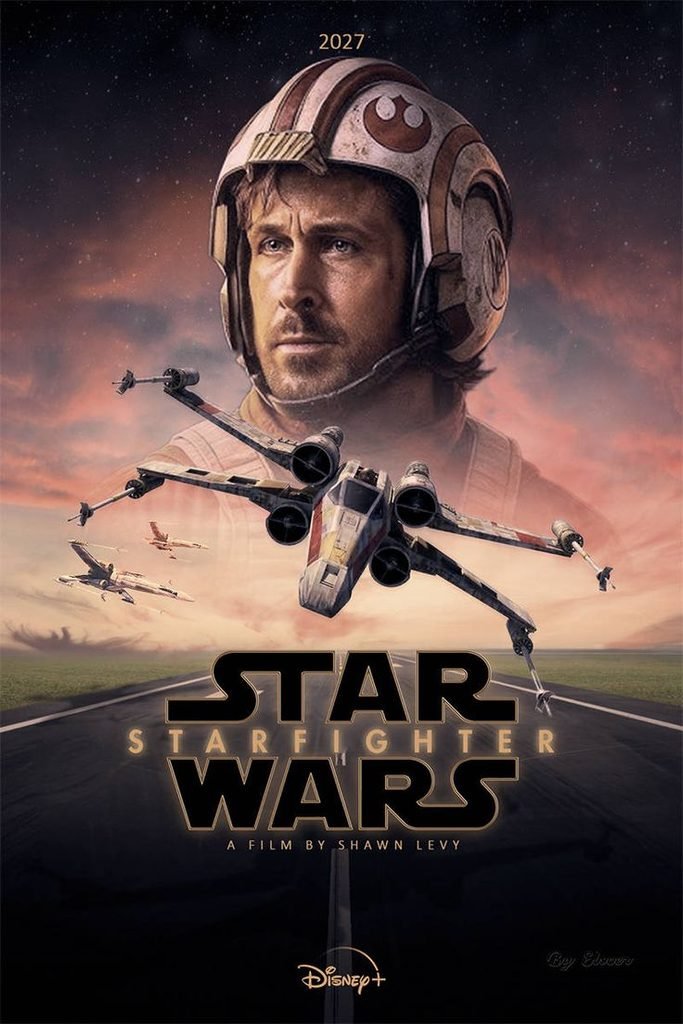
The Legacy of Starfighter Battles
From X-wings and TIE fighters onward, starfighter battles have stayed one of the most recognizable parts of Star Wars. The core formula is simple — pilot, spacecraft, enemy, objective, danger — but there’s endless room to vary it. A chase through a tight canyon feels totally different from an open-space battle. A one-on-one duel hits differently than a massive fleet engagement. A damaged fighter creates a different kind of tension than a fully operational one. That flexibility is exactly why the format keeps working for the franchise.
Sound Design: Making Combat Feel Powerful
Space itself is silent, but movies need sound to sell the action — and Star Wars has always had a distinctive language of engines, alarms, weapons fire, and cockpit chatter. Inside the cockpit especially, sound carries a lot of weight: engine vibration, warning alarms, control switches, weapons systems, comms chatter, structural impacts, even a pilot’s breathing. All of it helps a spacecraft feel like a real machine rather than a purely digital object.
Music matters too. A chase can start quiet and build toward a big maneuver; a dangerous moment can get a sudden musical shift; a win can land with real musical payoff. Star Wars has always used its score to make action sequences memorable — not just exciting, but genuinely communicating fear, urgency, hope, or determination.
Shooting and Editing the Action
Cockpit cinematography needs careful composition — wide shots to establish the space, medium shots for hands on controls, close-ups for reaction, point-of-view shots for what the pilot actually sees. Switching between all of these is what creates visual rhythm.
Editing carries just as much weight. Shots that run too long can make the action feel sluggish; shots that are too short can leave viewers lost. The goal is balancing intensity with clarity — especially with multiple ships involved, where every cut needs to preserve enough spatial information for the audience to keep up.
Designing the Ships Themselves
Spacecraft design does real storytelling work too — it’s not just about looking cool. A compact fighter suggests speed and agility; a larger ship suggests firepower or durability. Cockpit layout can say a lot about a pilot’s character and the technological sophistication of whoever built the ship — every button, screen, switch, and control stick contributes to that visual identity.
The bond between pilot and machine is one of the more compelling threads in stories like this. A good pilot knows their ship intimately — how far they can push it, what an unusual sound means, where its strengths and weaknesses lie. That relationship can build character without a single line of dialogue: a pilot who starts out struggling with their ship and ends up flying it on pure instinct is a classic, effective arc.
Why practical filmmaking helps performance: Picture an actor in an empty studio pretending a ship is shaking around them, versus an actor sitting in a cockpit that’s genuinely tilting, moving, and vibrating. The second gives them real sensory information to react to, which tends to read more naturally on camera. That doesn’t automatically make practical effects “better” — it depends entirely on how well they’re designed and combined with everything else.
Why This Kind of Story Stays Popular
Starfighter stories work because they combine so many familiar, reliable elements — speed, competition, risk, skill, heroism, survival. The setup is instantly understandable: someone’s flying, someone’s chasing them, something important is on the line. That simplicity is exactly what frees filmmakers to focus on pulling off the execution well.
Final Thoughts
Star Wars: Starfighter has real potential to dig into one of the franchise’s most recognizable kinds of action — the dogfight. Practical gimbal cockpits, physical performance, digital environments, high-G kinematics, detailed sound design, and dynamic cinematography can all come together into something genuinely powerful.
But the pilot is still what matters most. The technology creates the spectacle — the character creates the connection. When audiences understand what a pilot wants, what they’re afraid of, and what they’re fighting to protect, even the biggest space battle becomes something that actually means something.
Star Wars has spent decades building the visual language of space combat, and a new starfighter-focused film has the chance to build on that legacy using tools that weren’t available before — making cockpit action feel more physical and immediate than ever. Done right, that combination — tactile, practical realism alongside the massive scale modern visual effects allow — could make Star Wars: Starfighter a genuinely memorable addition to the franchise’s long history of space combat.
Frequently Asked Questions
What is Star Wars: Starfighter?
A Star Wars feature centered on starfighter combat and the pilots flying those ships.
What are practical gimbal cockpits?
Physical cockpit sets mounted on mechanical rigs that can move, tilt, or rotate to simulate a spacecraft in motion.
What does high-G mean?
It refers to acceleration forces well beyond normal gravity, placing serious physical strain on a person’s body.
Why are practical cockpits useful?
They give actors real physical environments and movement to react to, which can make their performances feel more natural.
Will Starfighter use CGI?
Almost certainly, in some capacity — modern Star Wars productions typically blend practical filmmaking with digital effects, with the exact balance depending on the sequence.
Why are dogfights so central to Star Wars?
They’ve been part of the franchise’s visual identity since the original 1977 film and remain one of its most recognizable elements.
What makes a great space battle?
Clear geography, understandable objectives, strong character motivation, dynamic cinematography, effective sound design, and carefully controlled editing.
Why does the cockpit matter so much?
It gives audiences a confined, grounded environment to experience the action through the pilot’s eyes, while still letting them see the character’s reactions play out in real time.
RashidCinePro brings you movie news, entertainment articles, cinematic analysis, reviews, and the latest stories from the world of film. 🎬🍿
Pingback: Captain America: Civil War – 7 Epic Battles